
Back to Chemistry
Chemistry
Biology

Home

Math
Physics

Next Topic
Back to Chemistry
Chemistry
Biology
Home
Math
Physics
Next Topic
Atomic structure is the arrangement of its smallest constituent elements (atoms, electrons, protons, neutrons, nucleus), which defines the properties of each material. Until the end of the 19th century, the atom was still considered an indivisible sphere. However, this belief only explained some general properties of matter, making it necessary to consider the atom as a complex system made up of subatomic particles.
The atom is composed of a nucleus, which is the central part, containing the protons and neutrons. It has the greatest mass and a density of:
10^13 to 10^14 g/cm^3
The electron corona is the outer part of the nucleus where the electrons orbit the center. They occupy most of the atom's volume. The diameter of the electron corona is always greater than the nucleus, even though the nucleus has a greater mass.
Electrons and protons determine the chemical properties of elements. Neutrons do not participate in chemical reactions under normal conditions.

For a better understanding, let's look at the atomic structure of hydrogen, the first element on the periodic table.
The hydrogen atom has a nucleus with 1 proton and 0 neutrons, and there is 1 electron in the electron crown:

The subatomic particles of the atom are neutrons, protons, and electrons. Let's define each of them.
Electrons are denoted by the symbol "e-"" and their mass is 9.10938 ×10^28 g, which shows that they are much lighter than a proton. The analogy is correct because electrons orbit the atomic nucleus at high speeds.
The unit of electronic charge is −1, and an electrically neutral atom will have the same number of protons and neutrons:
When atoms lose electrons, they become ions with a positive charge called cations.
When atoms gain electrons, they acquire a negative charge and become ions called anions.
Since the beginning of the 20th century, it was known that atoms are electrically neutral; therefore, the number of electrons and protons must be the same.
In 1910, New Zealand physicist Ernest Rutherford proposed that the positive charges of atoms were concentrated in a dense central cluster within the atom, which he called the nucleus.
The positively charged particles present in the nucleus are called protons; their symbol is p. Various experiments have shown that they have the same amount of charge as electrons.
The mass of the proton is 1.67262 x 10^-24 g, equal to that of the hydrogen atom. Remember that the hydrogen atom has only one proton in the nucleus.
The atomic number of an element on the periodic table is the number of protons it contains in its nucleus. Therefore, the value of the atomic number also represents the number of electrons present in an uncharged atom.
For example, the atomic number of chlorine is 17, which means that each Cl atom has 17 protons and 17 electrons.
Experiments after Rutherford's showed that the atom is made up of a third type of subatomic particle, which Chadwick called neutrons.
Neutrons are electrically neutral particles, with a mass similar to protons, but slightly larger; their mass is 1.67493 x 10^-24 g.
The sum of the neutrons and protons present in the nucleus of an element is called the atomic mass, and its value will always be a whole number.
The rule excludes hydrogen, since its nucleus contains one proton and no neutrons.
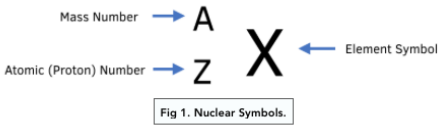
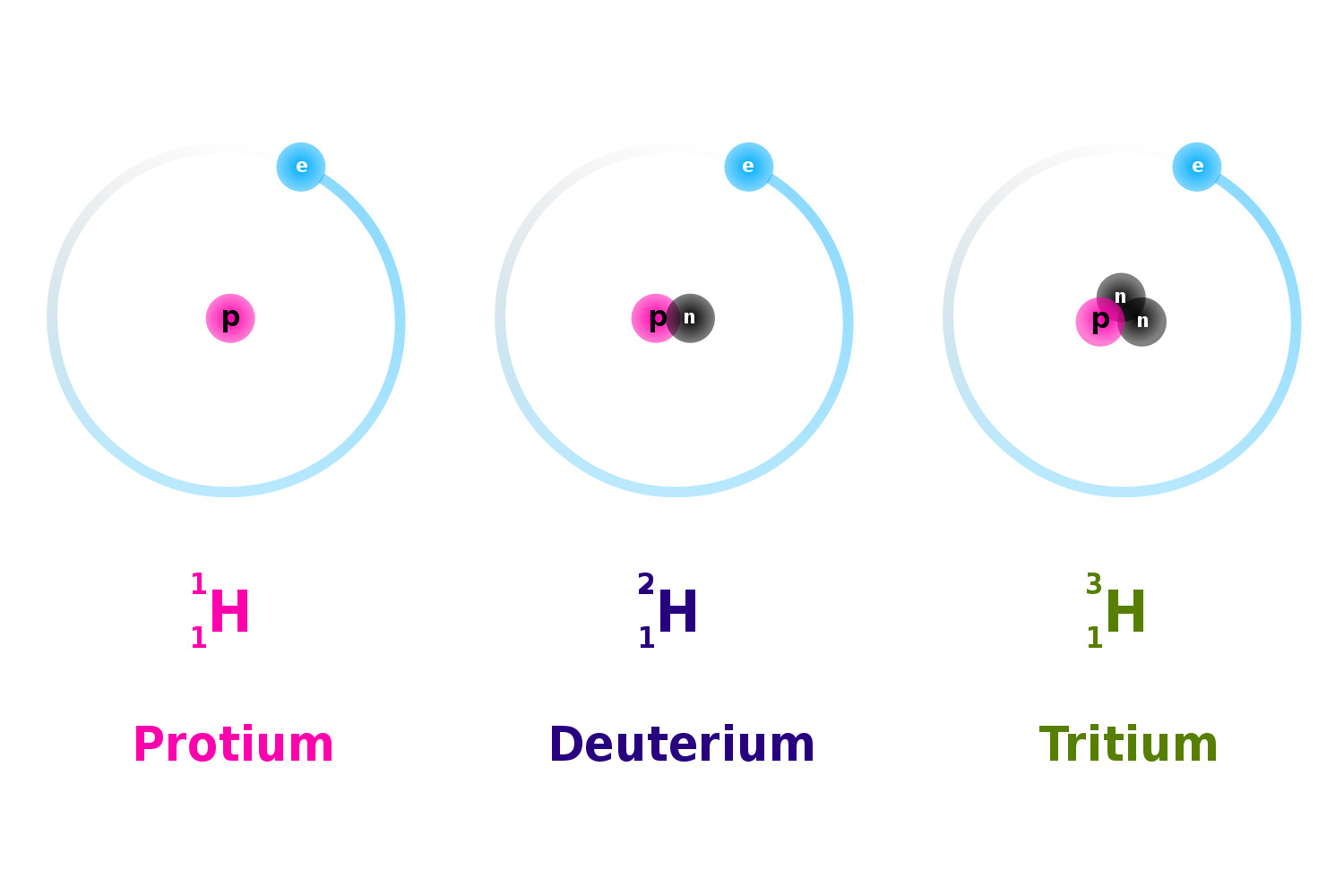
There are different elements that contain the same number of protons, but they differ in the number of neutrons and are called isotopes. In other words, isotopes have the same atomic number, but differ in mass.
As we have studied, hydrogen has only one proton in the nucleus and no electrons, therefore its isotopes would be:
Erwin Schrödinger devised the wave equation to explain the duality of matter. The solution to this equation is the wave function, which depends on three variables known as quantum numbers, which are s, l, m, and n.
Schrödinger's wave equation gives rise to the concept of an atomic orbital, which is the space most likely to hold an electron. However, orbitals are not a physical entity but rather a mathematical one, so the study of the atom is currently quite abstract.
How are protons held together in the nucleus of an atom if like charges repel each other? The answer is thanks to the strong nuclear force.
Also called the strong nuclear force, it is the force that overcomes the tendency for repulsion between elements of the same charge, that is, it prevents proton repulsion. It acts between subatomic particles very close to each other, maintaining the proton-neutron and neutron-proton interactions.
Remember to review the answers to the open-ended questions at the bottom of this page.
Once you click this button, the questions will close and you won't be able to change your answer.
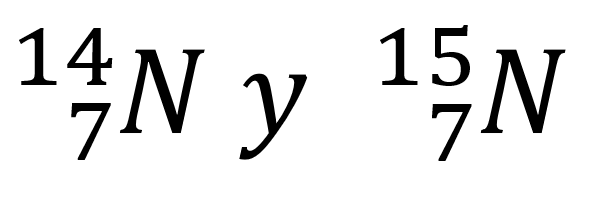
Remember that the atomic mass or mass number is the sum of the number of neutrons and the number of protons. A = N + P
We recommend visiting the following material for greater knowledge or understanding of the topic:
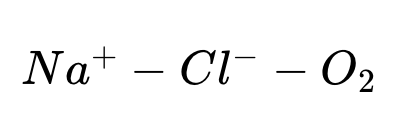
1. Atom 2. Atomic Structure 3. Atomic Structure6. Cation is Na+ because it lost an electron and gained a positive charge.
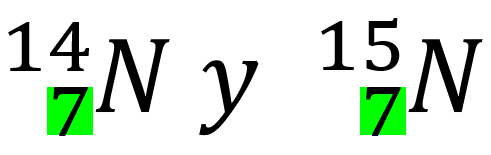
7. They are considered isotopes of nitrogen because they have the same number of protons, but differ in the number of neutrons.
8. N = 120 | Since the atom is uncharged, that is, it is in a neutral state, the number of protons will equal the number of electrons, therefore Hg has 80 e-.
9. The Schrödinger wave equation is a mathematical formula that describes the behavior of electrons in an atom. Its solution is the wave function, which depends on several quantum numbers and represents the probability of finding an electron in a specific region.
10. When an atom gains electrons, it acquires a negative charge and becomes an anion, since the number of electrons exceeds the number of protons.
References:
1. Max. (2024, 12 marzo). ¿Qué es la estructura atómica? Concepto, ejemplos y explicación. Unibetas Curso Examen de Admisión Online. https://unibetas.com/estructura-atomica/
2. McGrayne, Bertsch, S., Trefil, James, Bertsch, & F, G. (2025, 21 abril). Atom | Definition, Structure, History, Examples, Diagram, & Facts. Encyclopedia Britannica. https://www.britannica.com/science/atom/Atomic-mass-and-isotopes
3. Atomic Structure. (2012). ScienceDirect. https://www.sciencedirect.com/topics/earth-and-planetary-sciences/atomic-structure
4. Atomic structure | ARPANSA. (s. f.). ttps://www.arpansa.gov.au/understanding-radiation/what-is-radiation/ionising-radiation/atomic-structure#:~:text=Atoms%20consist%20of%20an%20extremely,the%20mass%20of%20the%20atom.
5. The Organic Chemistry Tutor. (2017, 23 septiembre). Chemistry - atomic structure - EXPLAINED! [Vídeo]. YouTube. https://www.youtube.com/watch?v=OH-aSu-rWgk
6. The Great Courses. (2016, 2 noviembre). The Basic Structure of the Atom | Chemistry and Our Universe: How it All Works [Vídeo]. YouTube. https://www.youtube.com/watch?v=Ml1bk9wDXVo
7. FuseSchool - Global Education. (2020, 9 marzo). Atom Structure | Matter | Physics | FuseSchool [Vídeo]. YouTube. https://www.youtube.com/watch?v=4SQEJJa1uDc