
Previous Topic

Chemistry

Biology

Home

Math

Physics

Next Topic
Previous Topic
Chemistry
Biology
Home
Math
Physics
Next Topic
A sequence is a set of things (usually numbers) in a certain order.
If the sequence goes on forever, it's an infinite sequence; if not, it's a finite sequence.
Examples:
{1, 2, 3, 4...} is a very simple sequence, and it's an infinite sequence.
{20, 25, 30, 35...} is also an infinite sequence.
{1, 3, 5, 7...} is the sequence of odd numbers, and it's infinite.
{4, 3, 2, 1} goes from 4 to 1 backward.
{1, 2, 4, 8, 16, 32...} It is an infinite sequence where we multiply each term.
{a, b, c, d, e} It is the sequence of the letters of the alphabet, and it is finite.
{a, l, f, r, e, d, o} It is the sequence of the name "Alfredo", and it is finite.
{0, 1, 0, 1, 0, 1, ...} It is the sequence that alternates 0s and 1s. They follow an order, in this case an alternative order.
When we say that the terms are "in order," we are the ones who say what order. It could be forward, backward, alternating, as long as the entire sequence follows the same order.
A sequence is very similar to a set, except that the terms are in order. In sets, the order doesn't matter, and the same value can appear many times, while in sets, it only appears once.
For example: {0, 1, 0, 1, 0, 1, ...} is the sequence that alternates 0s and 1s. The set would simply be {0, 1}.
Sequences also use the same notation as sets: each element is numbered, separated by a comma, and then braces are placed around each element. {3, 5, 7, ...}
A sequence follows a rule that tells you how to calculate the value of each term.
Example: the sequence {3, 5, 7, 9, ...} starts at 3 and skips 2 each time.
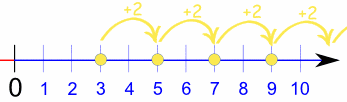
But the rule should be a formula. Saying "it starts at 3 and skips 2 each time" doesn't tell us how to calculate the 10th or 100th term.
So we want a formula with "n" in it (where n is the position of the term).
We see that the sequence goes up by 2 each time, so we can guess that the rule is going to be "2 × n".
This almost works... but the rule always gives values 1 unit less than it should, so we change it to 2n+1 and it works.
So instead of saying "start at 3 and skip 2 each time" we write the rule as 2n+1
Now, for example, we can calculate the 100th term: 2 × 100 + 1 = 201
To make it easier to write the rules, usually "xn" is the term, and "n is the position of that term.
Then we can write a rule for {3, 5, 7, 9, ...} as an equation, like this:
xn = 2n+1
Now, if we want to calculate the 10th term, we can write:
x10 = 2n+1 = 2×10+1 = 21
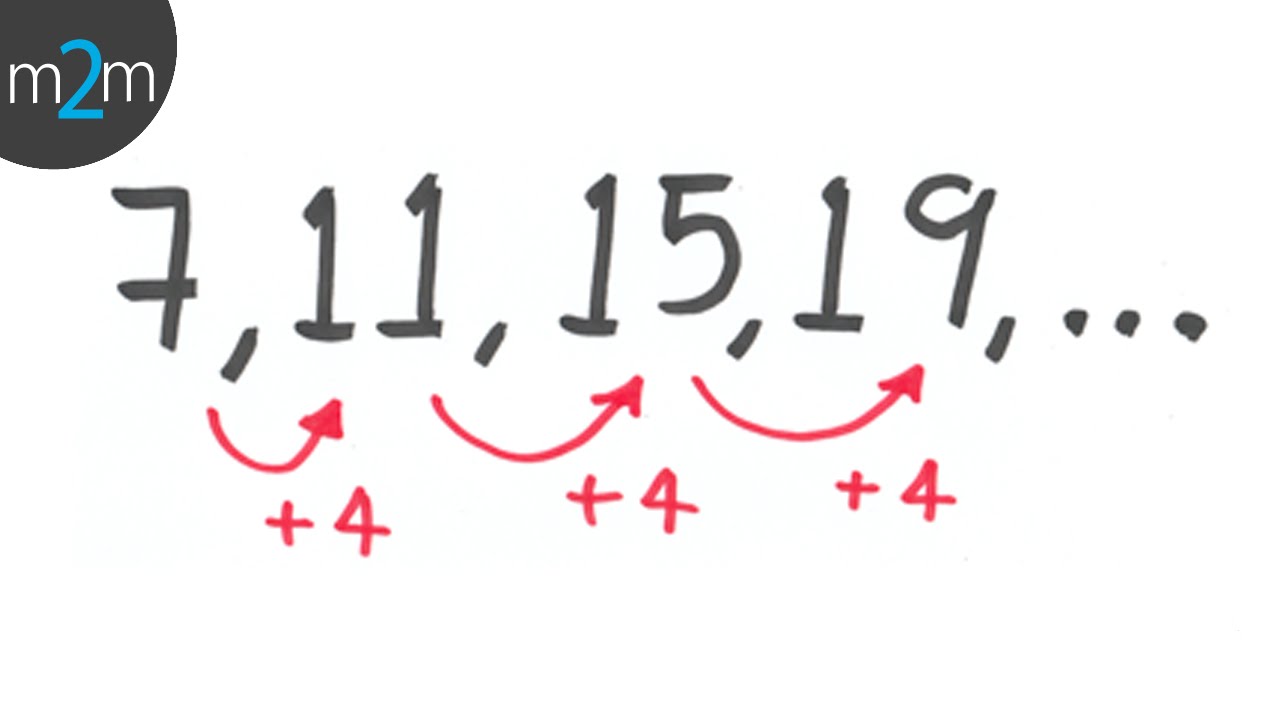
The example we just used, {3,5,7,9,...}, is an arithmetic sequence because the difference between one term and the next is a constant.
In general, we can write an arithmetic sequence like this: {a, a+d, a+2d, a+3d, ...}
Where a is the first term, and d is the difference between the terms, called the "common difference."
And we can establish the rule: xn = a + d(n-1). We use "n-1" because the d is not used in the first term.
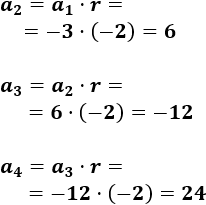
In a geometric sequence, each term is calculated by multiplying the previous one by a constant.
For example: {2, 4, 8, 16, 32, 64, 128, 256, ...}. This sequence has a factor of 2 between every two terms. The rule is xn = 2n.
In general, we can write a geometric sequence like this: {a, ar, ar2, ar3, ... } where: a is the first term, and r is the ratio between each pair of terms, called the "common ratio".
Note: r cannot be 0. When r=0, we get the sequence {a,0,0,...}, which is not geometric.
And the rule is: xn = ar(n-1). We use "n-1" because ar0 is the first term.
The Triangular Sequence is generated from a pattern of points in a triangle.
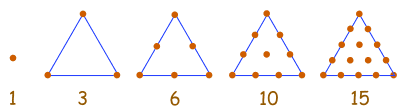
By adding another row of points and counting the total, we find the next number in the sequence. But it's easier to use the rule: xn = n(n+1)/2
Example: The fifth triangular number is x5 = 5(5+1)/2 = 15, and the sixth is x6 = 6(6+1)/2 = 21
The next number is calculated by squaring its position in the sequence. {1, 4, 9, 16, 25, 36, 49, 64, 81, ...}
The rule is xn = n^2
The next number is calculated by cubing its position. {1, 8, 27, 64, 125, 216, 343, 512, 729, ...}
The rule is xn = n3
The next number is calculated by adding the two numbers before it. 2 is calculated by adding the two before it (1+1). 21 is calculated by adding the two before it (8+13).
{0, 1, 1, 2, 3, 5, 8, 13, 21, 34, ...}
The rule is xn = xn−1 + xn−2
Example: the 6th term would be calculated like this: x6 = x6−1 + x6−2 = x5 + x4 = 5 + 3 = 8
When we add only part of the sequence, we say that we are doing a partial sum.
But a sum of an infinite sequence is called a "series"; it sounds like another name for sequences, but it's actually a sum.
Example: Odd numbers: Sequence: {1, 3, 5, 7, ...}, Series: 1 + 3 + 5 + 7 + ..., Partial sum of the first three terms: 1 + 3 + 5
Remember to review the answers to the open questions at the bottom of this page.
Once you click this button, the questions will close and you will not be able to change your answer.
We recommend visiting the following material for further knowledge or understanding of the topic:
1. Introduccion to Sequenses and Series6. In a set, the order doesn't matter, and elements are not repeated; in a sequence, the order matters, and terms can be repeated.
7. An infinite sequence never ends; a finite sequence has a limited number of terms.
8. {3, 5, 7, 9, 11}
9. {0, 1, 1, 2, 3, 5}
10. In arithmetic, a fixed amount is always added; in geometrical mathematics, it is multiplied by a constant.
References:
1. Sucesiones y series. (s. f.). https://www.disfrutalasmatematicas.com/algebra/sucesiones-series.html https://www.disfrutalasmatematicas.com/algebra/sucesiones-series.html
2. Libretexts. (2021, 6 octubre). 9.1: Introduction to Sequences and Series. Mathematics LibreTexts. https://math.libretexts.org/Bookshelves/Algebra/Advanced_Algebra/09%3A_Sequences_Series_and_the_Binomial_Theorem/9.01%3A_Introduction_to_Sequences_and_Series https://math.libretexts.org/Bookshelves/Algebra/Advanced_Algebra/09%3A_Sequences_Series_and_the_Binomial_Theorem/9.01%3A_Introduction_to_Sequences_and_Series
3. Admin. (2022b, octubre 4). Sequence and Series. BYJUS. https://byjus.com/maths/sequence-and-series/ https://byjus.com/maths/sequence-and-series/
4. Calculus II - series & sequences. (s. f.). https://tutorial.math.lamar.edu/classes/calcii/seriesintro.aspx https://tutorial.math.lamar.edu/classes/calcii/seriesintro.aspx
5. Mario’s Math Tutoring. (2019, 3 abril). Sequences and Series (Arithmetic & Geometric) Quick Review [Vídeo]. YouTube. https://www.youtube.com/watch?v=Tj89FA-d0f8 https://www.youtube.com/watch?v=Tj89FA-d0f8
6. The Organic Chemistry Tutor. (2021, 13 mayo). Arithmetic Sequences and Arithmetic Series - Basic Introduction [Vídeo]. YouTube. https://www.youtube.com/watch?v=XZJdyPkCxuE https://www.youtube.com/watch?v=XZJdyPkCxuE
7. Professor Dave Explains. (2018a, junio 15). Convergence and Divergence: The Return of Sequences and Series [Vídeo]. YouTube. https://www.youtube.com/watch?v=L-JqHo4-W4k https://www.youtube.com/watch?v=L-JqHo4-W4k