
Previous Topic

Chemistry

Biology

Home

Math

Physics

Next Topic
Previous Topic
Chemistry
Biology
Home
Math
Physics
Next Topic
Matrices are a two-dimensional set of numbers or symbols arranged in a rectangular shape, along vertical and horizontal lines, with their elements organized into rows and columns. They are used to describe systems of linear or differential equations, as well as to represent a linear transformation.
Every matrix is represented by a capital letter, and its elements are enclosed in two lowercase parentheses or brackets. They also have double superscripts: the first refers to the row and the second to the column to which they belong.
This mathematical expression can be added, multiplied, and decomposed, so its use is common in linear algebra.
A matrix can be:
1. Rectangular: Has different numbers of rows and columns.
2. Row: A rectangular matrix with only one row.
3. Column: A rectangular matrix with only one column.
4. Null: A matrix whose elements are equal to zero.
5. Square of order n: A matrix that has the same number of rows as columns. In this type of matrix, the dimension is called the order, and its value is the same as the number of rows and columns.
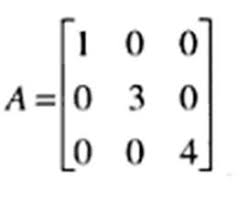
6. Diagonal: A type of square matrix in which the elements not on the main diagonal are equal to zero.
7. Scalar: A diagonal matrix in which all elements on the main diagonal are equal.
8. Identity: A scalar matrix in which the elements on the main diagonal are equal to one, while the remaining elements are equal to zero.
9. Opposite: A matrix opposite to another matrix whose elements have a sign opposite to the main matrix. That is, the matrix opposite to A is called -A and all the elements of the set are opposite to the elements of the matrix A.
10. Transpose: This is the matrix obtained by converting the rows into columns. The superscript t is used to represent it and its dimension is n x m.
11. Upper triangular: This is a square matrix in which at least one of the terms above the main diagonal is non-zero, and all those below it are equal to zero.
12. Lower Triangular: Unlike the previous type, in this type of matrix, at least one of the elements below the main diagonal is nonzero, and all those above it are equal to zero.
Rectangular
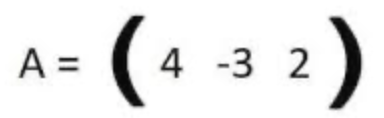
Row
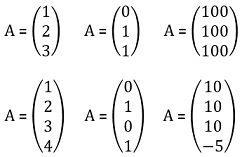
Column
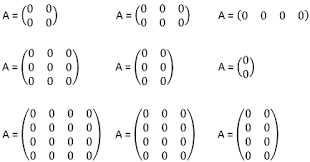
Null

Square of order n
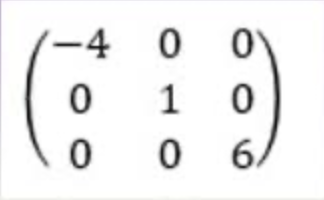
Diagonal
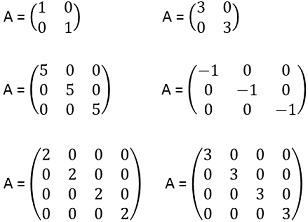
Scale
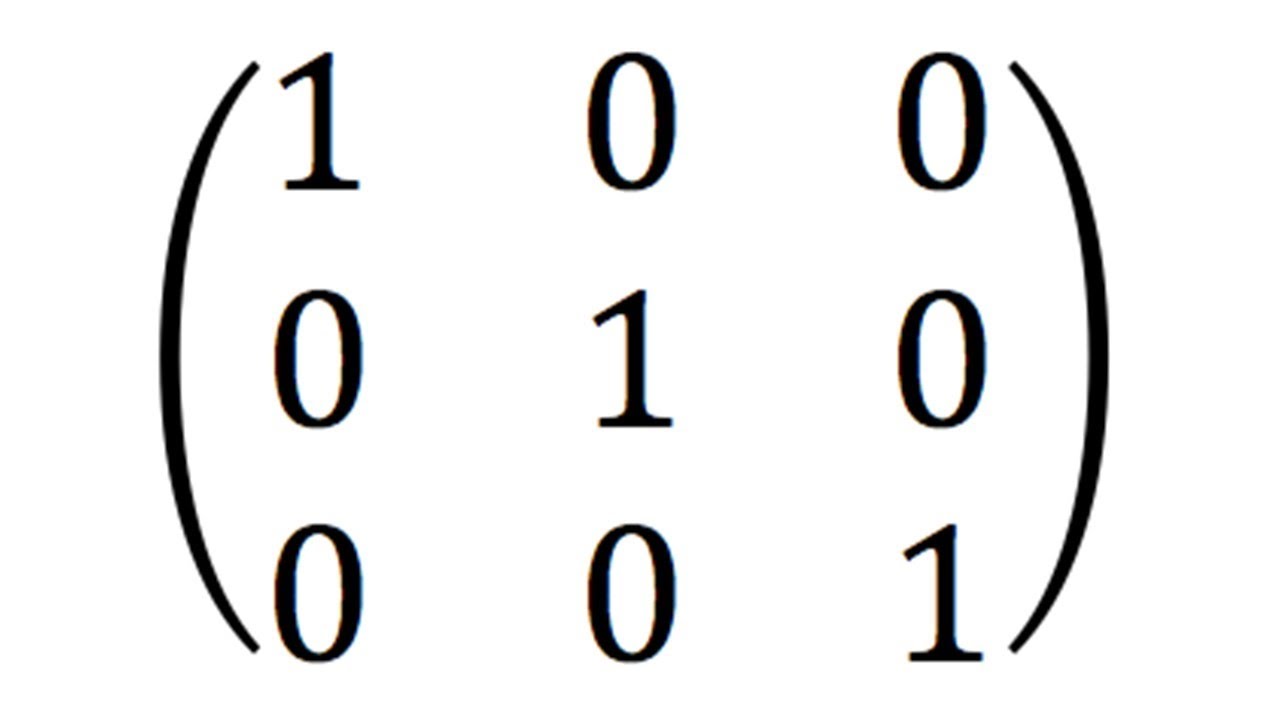
Identity
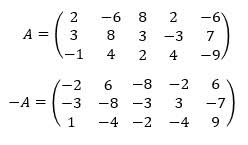
Opposite
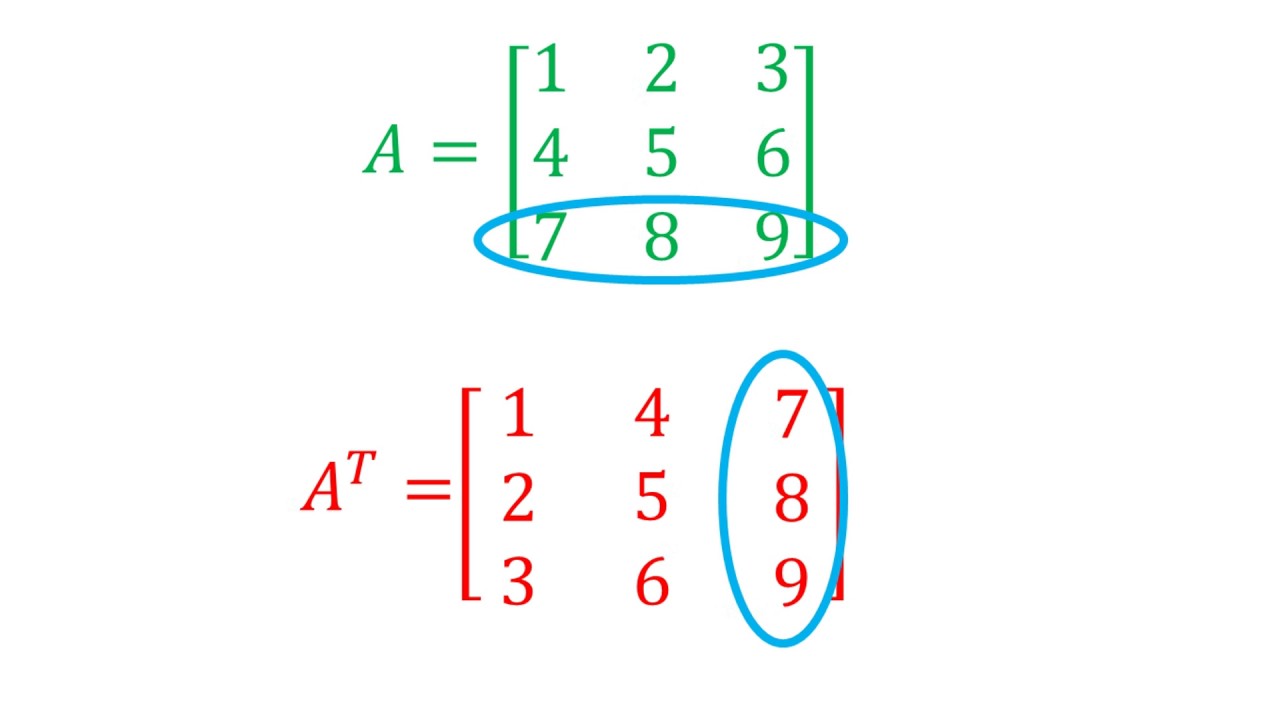
Transposed
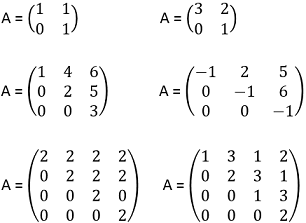
Upper triangular
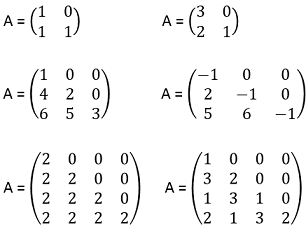
Lower triangular
Matrices have multiple applications, especially for representing coefficients in systems of equations or linear transformations. The matrix can perform the same function as the data of a vector in a linear transformation system.
Computer science is one of the fields in which matrices are most used due to their effectiveness in manipulating information. Matrices are ideal for graphical representations and for animating shapes.
In robotics, matrices are used to program robots that can perform different tasks. An example of this is a bionic arm that, through programmable mechanical processes, can perform functions similar to those of a human arm. All of this programming is the result of calculations using matrices.
Determinants are scalar values associated with square matrices, that is, matrices in which the number of rows equals the number of columns. The determinant of a matrix is a numerical measure that provides important information about the matrix and its associated linear transformations. In general terms, the determinant of a matrix A is denoted as "det(A)" or "|A|".
Determinants appeared in Western culture in the 16th century, preceding the advent of matrices, which were not studied until the 19th century. This was possible because during the first centuries, they were not formally treated; they were merely a "gadget" for determining the solution of systems of equations.
During the 18th and 19th centuries, prominent mathematicians contributed to the development of the properties of determinants. Most historians agree that the theory of determinants originated with the German mathematician Gottfried Wilhelm Leibniz, who used determinants in 1693 in connection with systems of simultaneous linear equations. However, some argue that the Japanese mathematician Seki Kowa did the same thing a few years earlier.
One of the major contributors to the advancement of determinant theory was the French mathematician Augustin-Louis Cauchy, who, in 1812, wrote an 84-page memoir containing the first proof of the formula "det(A*B) = det(A) * det(B)".
Moreover, the expansion of determinants by cofactors was first used by the French mathematician Pierre-Simon Laplace. Besides him, a prominent contributor to determinant theory was the German mathematician Carl Gustav Jacobi, who eventually popularized the term "determinant."
Determinants have several properties that make them especially useful in linear algebra and solving systems of linear equations. These properties include:
Swapping rows or columns: Swapping two adjacent rows or columns in a matrix changes the sign of the determinant.
This means that "det(-A)" = "-det(-A)" if we swap two rows (or columns) of matrix A.
Zero determinant if rows are linearly dependent: If we make a determinant of a matrix with two rows or two columns proportional (this also includes making a row or a column zero), then the determinant equals 0.
Determinant of a transposed matrix: The determinant of a transposed matrix is equal to the determinant of the original matrix, i.e., "det(A^t)" = "det(A)".
Product of determinants: The determinant of a product of two matrices A and B is equal to the product of the determinants of A and B, that is, "det(A*B)" = "det(A) * det(B)".
Determinant of the identity matrix: The determinant of the identity matrix of any order n is equal to 1, that is, "det(I_n) = 1". This property is of great importance when solving matrix equations, because it implies that the absolute value of any other matrix is unaffected when multiplied by the identity matrix.
Multiplication by a scalar: If we multiply a matrix A by a scalar k, the determinant of the resulting matrix is kⁿ times the determinant of A, where n is the order of the matrix.
Laplace's rule, also known as the rule of cofactor expansion or cofactor expansion, was developed by the French mathematician Pierre-Simon Laplace and is a method used to calculate the determinant of a square matrix of order greater than 2. This rule is based on the idea of decomposing a matrix into smaller "submatrices" and calculating their determinants. The general steps for calculating the determinant of an n matrix using Laplace's rule are as follows:
Choose a row or column of the original matrix. It is advisable to choose the one that contains the most zeros or that simplifies the calculations. For each element a_ij in the selected row or column, its cofactor C_ij will be calculated. The cofactor C_ij is obtained by taking the determinant of the matrix A_ij, which results from deleting row i and column j from the original matrix, and then multiplying it by (-1)^(i+j).
Finally, the determinant of A is obtained by multiplying each cofactor C_ij by the corresponding element and adding them all together. If calculating the cofactors fails to resolve the determinant of A_ij, Laplace's rule must be applied to this matrix again until an order is obtained that allows its determinant to be calculated.
How to calculate the determinant of a matrix of order 2?
Calculating the determinant of a matrix of order 2 is a simple and straightforward procedure. Thus, given a matrix A of order 2, its determinant is calculated as follows: Det(A) = a_11 * a_22 – a_12 * a_21
That is, multiply the upper left element by the lower right element and then subtract the product of the upper right element by the lower left element.
How to calculate the determinant of a matrix of order 3?
For matrices of order 3, the determinant can be obtained using two techniques: Laplace's rule or cofactor expansion, and Sarrus's rule. The latter allows for easier resolution of determinants of matrices of order 3 than applying Laplace's rule. Thus, given a matrix A of order 3, the matrix is rewritten as follows:
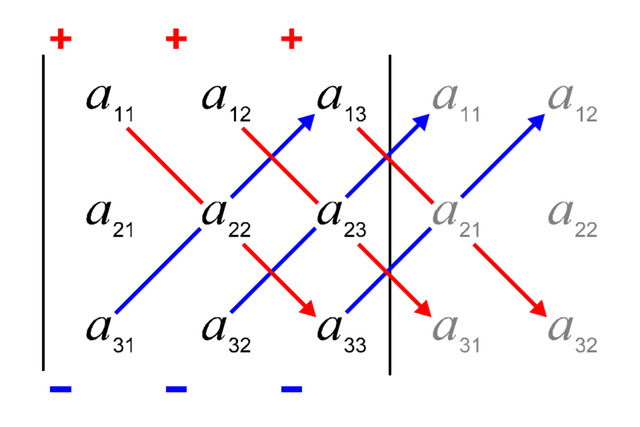
The determinant of the matrix A is calculated by multiplying the elements of the diagonals by each other and by -1 (in the case of the blue diagonals) or by +1 (for the red diagonals) and then adding the result obtained in each diagonal. Mathematically, this is written as:
Det(A) = a_11 * a_22 * a_33 + a_12 * a_23 * a_31 + a_21 * a_32 * a_13 – a_13 * a_22 * a_31 – a_12 * a_21 * a_33 – a_23 * a_32 * a_11
In this case, the only option to obtain the determinant is to apply Laplace's rule, explained above.
What is the rank of a matrix and what is its relationship to determinants?
The rank of a matrix is the maximum number of linearly independent columns a matrix has. In other words, the rank of a matrix indicates how many columns of the matrix are needed to generate all the other columns through linear combinations. To calculate the rank of a matrix, one can use the Gauss method or calculate the rank through minors. A minor is the determinant of a square matrix obtained by eliminating any number of rows or columns from a matrix. Thus, the rank of a matrix A can be calculated by obtaining the order of the largest square "submatrix" (minor) whose determinant is nonzero.
First, the square matrix of highest possible order must be found and its determinant calculated. If this is nonzero, the rank of A is the order of this matrix, and no further calculations are necessary. However, if the determinant is zero, a lower-order "submatrix" (minor) must be found whose determinant is nonzero.
This process is repeated as many times as necessary, decreasing the order of the minors until one is found whose determinant is nonzero. Thus, the rank of A will ultimately be the order of the first minor whose determinant is nonzero. The rank is a fundamental concept for determining the number of solutions to a system of linear equations. Depending on the rank of the extended matrix—that is, the one that includes the coefficients of the equations and the constant terms—and the rank of the vector of constant terms, we can determine whether the system will have a single solution, multiple solutions, or simply no solution.
What is the purpose of calculating the determinant of a matrix?
Determinants have a wide range of applications in mathematics and in various areas, including linear algebra, geometry, and physics. Some of the most important applications of determinants are:
Solving Systems of Linear Equations: As explained above, determinants are used to solve systems of linear equations, especially when determining whether a system has a single solution, multiple solutions, or no solutions.
Eigenvalues and Eigenvectors: Determinants are used to find the eigenvalues and eigenvectors of a matrix.
Graph Theory: Determinants are used in graph theory to count subgraphs and determine structural properties of graphs.
Matrix Inversion Calculation: Determinants are essential for calculating the inverse of a matrix. A matrix has an inverse if and only if its determinant is nonzero.
Remember to check the answers to the open questions at the bottom of this page.
Once you click this button, the questions will close and you won't be able to change your answer.
We recommend visiting the following material for greater knowledge or understanding of the topic:
1. Matrix6. A matrix is a rectangular array of numbers or symbols distributed in rows and columns, used to represent systems of equations or linear transformations.
7. A diagonal matrix can have any diagonal value, while a scalar matrix has all diagonal elements equal.
8. Determinants allow us to determine whether a system has a unique solution, infinite solutions, or none at all. For example, if the determinant of the coefficient matrix is nonzero, the system has a unique solution.
9. They are used to program and control movements, as in the case of bionic arms that imitate humans using matrix calculations.
10. Because it functions as the neutral element of matrix multiplication: multiplying any matrix by the identity gives the result of the original matrix.
References:
1. Qué son las matrices, conceptos asociados, tipos y aplicación - Ferrovial. (2024, 23 febrero). Ferrovial. https://www.ferrovial.com/es/stem/matrices/ https://www.ferrovial.com/es/stem/matrices/
2. ¿Qué es un determinante? (s. f.). Resueltoos.com. https://www.resueltoos.com/blog/matematicas/que-es-un-determinante https://www.resueltoos.com/blog/matematicas/que-es-un-determinante
3. The Editors of Encyclopaedia Britannica. (2025, 16 agosto). Matrix | Definition, Types, & Facts. Encyclopedia Britannica. https://www.britannica.com/science/matrix-mathematics https://www.britannica.com/science/matrix-mathematics
4. Libretexts. (2025, 31 marzo). 4.1: Determinants- definition. Mathematics LibreTexts. https://math.libretexts.org/Bookshelves/Linear_Algebra/Interactive_Linear_Algebra_(Margalit_and_Rabinoff)/04%3A_Determinants/4.01%3A_Determinants-_Definition https://math.libretexts.org/Bookshelves/Linear_Algebra/Interactive_Linear_Algebra_(Margalit_and_Rabinoff)/04%3A_Determinants/4.01%3A_Determinants-_Definition
5. The Organic Chemistry Tutor. (2018, 16 febrero). Intro to Matrices [Vídeo]. YouTube. https://www.youtube.com/watch?v=yRwQ7A6jVLk https://www.youtube.com/watch?v=yRwQ7A6jVLk
6. JensenMath. (2024, 23 agosto). Matrices Top 10 Must Knows (ultimate study guide) [Vídeo]. YouTube. https://www.youtube.com/watch?v=ZFVFtVbeerI https://www.youtube.com/watch?v=ZFVFtVbeerI
7. The Organic Chemistry Tutor. (2017, 25 abril). Determinant of 3x3 Matrices, 2x2 Matrix, Precalculus Video Tutorial [Vídeo]. YouTube. https://www.youtube.com/watch?v=3ROzG6n4yMc https://www.youtube.com/watch?v=3ROzG6n4yMc
8. Professor Dave Explains. (2018, 5 diciembre). Evaluating the Determinant of a Matrix [Vídeo]. YouTube. https://www.youtube.com/watch?v=CcbyMH3Noow https://www.youtube.com/watch?v=CcbyMH3Noow