Previous Topic

Chemistry

Biology

Home

Math

Physics

Next Topic
Previous Topic
Chemistry
Biology
Home
Math
Physics
Next Topic
Complex numbers are the combination of real and imaginary numbers. The real part can be expressed as an integer or its decimals, while the imaginary part is the part whose square is negative.
Complex numbers arise from the need to encompass the roots of negative numbers, something that real numbers cannot do. For this reason, they reflect all the roots of polynomials.
Their use spans different scientific fields, ranging from mathematics to engineering. Complex numbers can also represent electromagnetic waves and electric currents, so their use in the fields of electronics and telecommunications is fundamental.
Its mathematical formula is: a + b i, where a and b are real numbers and i is the imaginary number. This expression is known as the binomial form because of its two constituent components.
The French mathematician René Descartes was the first to emphasize the imaginary nature of numbers, stating that:
"One can imagine as many (numbers) as already stated in each equation, but sometimes there is no quantity that matches what we imagine."
However, the conceptualization of complex numbers dates back to the 16th century thanks to the contribution of the Italian mathematician Gerolamo Cardano, who showed that having a negative term within a square root can obtain the solution to an equation. Until then, it was not thought possible to obtain the square root of a negative number.
Later, in the 18th century, the mathematician Carl Friedrich Gauss consolidated Cardano's premises and developed a treatise on complex numbers in a plane, establishing the modern foundations of the term.

The real numbers involved in a complex number formula can be expressed in even, binomial, and vector forms.
The unit of imaginary numbers is called i and is equivalent to 1 for real numbers. Likewise, the square root of i is -1.
Two complex numbers are considered equal when they have the same real and imaginary components.
The set of all complex numbers is designated by the letter C. Similarly, C forms a two-dimensional vector space.
Unlike real numbers, complex numbers cannot maintain an order.
There are pure imaginary numbers, whose real part is 0 and whose formula is represented as follows: 0 + bi = bi.
Although their everyday application is not as direct as that of real numbers, complex numbers, due to their imaginary component, are important because they allow for very precise work in specific areas of science and physics, such as the measurement of electromagnetic fields, which consist of electric and magnetic components and require pairs of real numbers to describe them. These pairs can be viewed as complex numbers, hence their importance.
Any numerical category (whether natural, integer, or rational) can be represented graphically on a line. In the case of real numbers, they encompass the entire line, and each number corresponds to a place on the line (also called the real line).
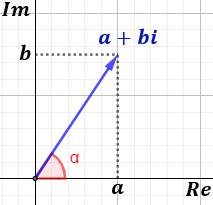
Complex numbers extend from the line to fill a plane, called the complex plane. In this case, complex numbers are represented on Cartesian axes, where the X axis is known as the real axis and the Y axis is known as the imaginary axis. The complex number formula a + bi is represented by the point or endpoint (a,b) called the affix or by an origin vector (0,0).
Remember to review the answers to the open questions at the bottom of this page.
Once you click If you click this button, the questions will close, and you won't be able to change your answer.
We recommend visiting the following material for further knowledge or understanding on the topic:
1. Complex Numbers in Math6. Because real numbers couldn't solve square roots of negative numbers.
7. When they have the same real part and the same imaginary part.
8. The X axis corresponds to the real part and the Y axis to the imaginary part. The number is represented as a point (a, b) or a vector.
9. It is i, and i² = -1.
10. In electrical engineering, to describe alternating currents or in telecommunications to represent electromagnetic waves.
References:
1. Números complejos: qué son, origen, características, relevancia - Ferrovial. (2022, 2 noviembre). Ferrovial. https://www.ferrovial.com/es/stem/numeros-complejos/ https://www.ferrovial.com/es/stem/numeros-complejos/
2. Admin. (2022, 25 agosto). Complex numbers. BYJUS. https://byjus.com/maths/complex-numbers/ https://byjus.com/maths/complex-numbers/
3. Complex numbers. (s. f.). https://www.mathsisfun.com/numbers/complex-numbers.html https://www.mathsisfun.com/numbers/complex-numbers.html
4. NCERT. (s. f.). Complex numbers and quadratic equations. https://ncert.nic.in/textbook/pdf/kemh104.pdf https://ncert.nic.in/textbook/pdf/kemh104.pdf
5. Khan Academy. (2014, 12 febrero). Introduction to complex numbers | Imaginary and complex numbers | Precalculus | Khan Academy [Vídeo]. YouTube. https://www.youtube.com/watch?v=SP-YJe7Vldo https://www.youtube.com/watch?v=SP-YJe7Vldo
6. Mathemaniac. (2021, 25 octubre). What do complex functions look like? | Essence of complex analysis #4 [Vídeo]. YouTube. https://www.youtube.com/watch?v=TaWBXRaNEcc https://www.youtube.com/watch?v=TaWBXRaNEcc
7. Professor Dave Explains. (2017, 11 diciembre). Complex Numbers: Operations, Complex Conjugates, and the Linear Factorization Theorem [Vídeo]. YouTube. https://www.youtube.com/watch?v=Yddjxj49C_M https://www.youtube.com/watch?v=Yddjxj49C_M