
Previous Topic

Chemistry

Biology

Home

Math

Physics

Next Topic
Previous Topic
Chemistry
Biology
Home
Math
Physics
Next Topic
A mathematical function (also called simply a function) is the relationship between one magnitude and another, when the value of the first depends on the second.
For example, if we say that the value of the temperature of the day depends on the time at which we check it, we will unwittingly be establishing a function between the two.
Dependent variable: This is the one that depends on the value of the other magnitude. In the example, it is temperature.
Independent variable: This is the one that defines the dependent variable. In the example, it's time.
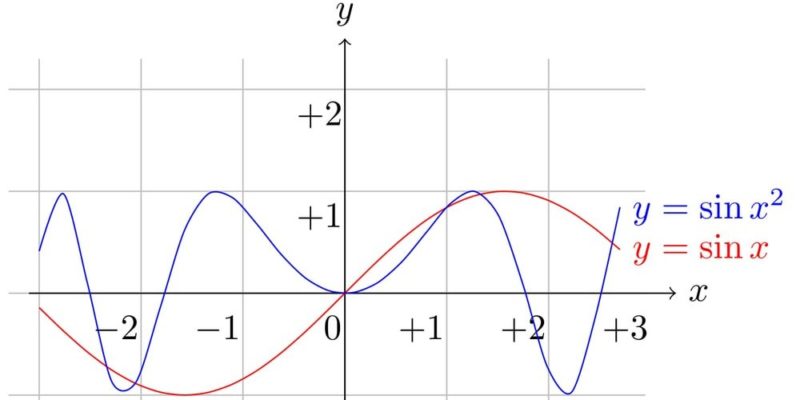
Thus, every mathematical function consists of the relationship between an element of group A and another element of group B, provided they are uniquely and exclusively linked.
Therefore, this function can be expressed in algebraic terms, using signs as follows:
f: A → B
a → f(a)
Where A represents the domain of the function (f), the set of starting elements, while B is the codomain of the function, that is, the arrival set.
F(a) denotes the relationship between an arbitrary object a belonging to the domain A, and the only object in B that corresponds to it (its image).
These mathematical functions can also be represented as equations, using variables and arithmetic signs to express the relationship between the magnitudes.
These equations, in turn, can be solved by solving for their unknowns or graphed geometrically.
Mathematical functions can be classified according to the type of correspondence between the elements of domain A and those of B, resulting in the following:
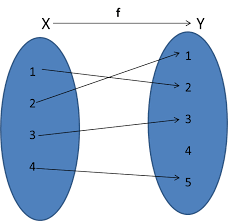
Injective Function. Any function will be injective if different elements of domain A correspond to different elements of domain B, that is, no element of the domain corresponds to the same image of another.
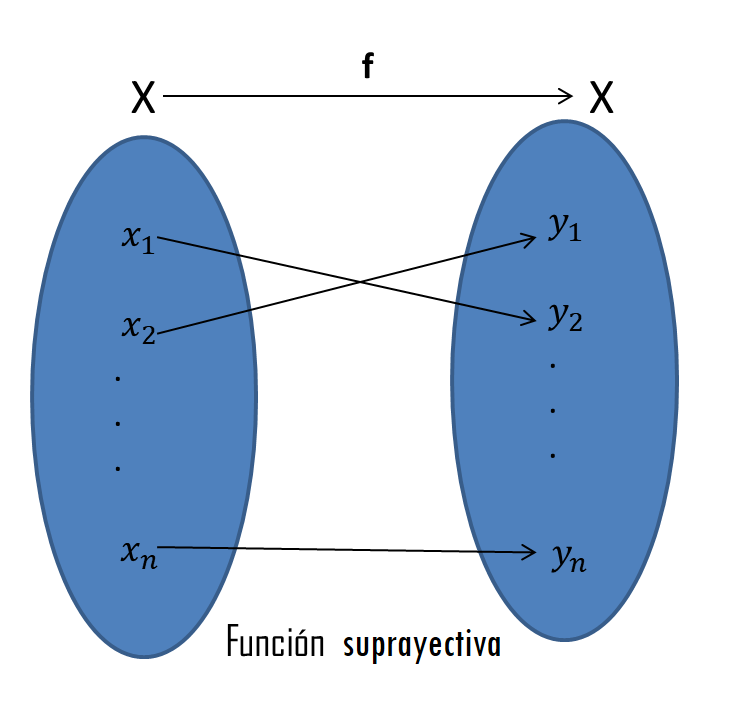
Surjective Function. Similarly, we will talk about a surjective function (or (subjective) when each element of domain A corresponds to an image in B, even if this means sharing images.
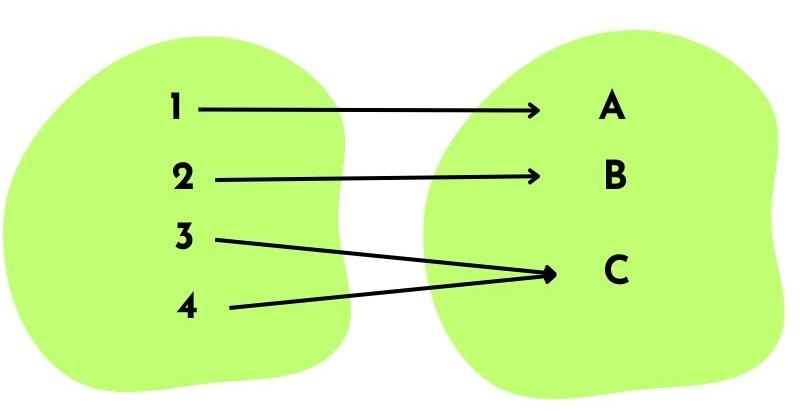
Bijective function. Occurs when a function is both injective and surjective, that is, when each element of A corresponds to a single element of B, and there are no unassociated images in the codomain, that is, there are no elements in B that do not correspond to one in A.

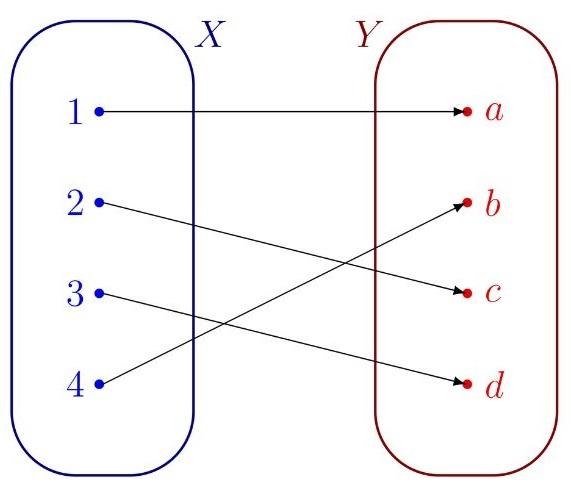
The set "x" is the domain.
The set "y" is the codomain.
The set of elements indicated by "y" (the actual values produced by the function) are the range, also called the range.
We have:
Domain: {1,2,3,4}
Codomain: {1,2,3,4,5}
Range: {1,2,3,5}
What comes out (the range) depends on what we put in (the domain), but we can define the domain.
In fact, the domain is an essential part of the function. A different domain gives a different function.
Example: a simple function like f(x) = x^2 can have as its domain the counting numbers {1,2,3,...}, and the range will then be the set {1,4,9,...}.

And another function g(x) = x2 can have as its domain the integers {...,−3,−2,−1,0,1,2,3,...}, then the range will be the set {0,1,4,9,...}.

Although both functions take the input and square it, they operate on different sets of inputs, and therefore give different outputs.
The codomain and range have to do with the output, but they are not exactly the same.
The codomain is the set of values that could be output. The codomain is actually part of the function definition.
The range is the set of values that are actually output.
Example: you can define a function f(x)=2x with the domain and codomain being the integers (because you chose it that way).
But if you think about it, you'll see that the range (the values that are actually output) are only the even integers.
So the codomain is the integers (you chose it), but the range is the even integers.
Remember to check the answers to the open-ended questions at the bottom of this page.
Once you click this button, the questions will close and you won't be able to change your answer.
We recommend visiting the following material for further knowledge or understanding of the topic:
1. What is a Function?6. The codomain is the set of values that could appear; while the range is the set of values that actually appear.
7. In the relationship between one element of group A and another element of group B,
8. {2,5,10}
9. {1,2,3}
10. {-6, 6, 26}
References:
1. Equipo editorial, Etecé. (2021a, julio 16). Función Matemática - Concepto, variables, tipos y características. Concepto. https://concepto.de/funcion-matematica/
2. Dominio, codominio y rango. (s. f.). https://www.disfrutalasmatematicas.com/conjuntos/dominio-rango-codominio.html
3. Admin. (2022a, agosto 17). What is a Function? BYJUS. https://byjus.com/maths/what-is-a-function/#:~:text=A%20function%20is%20defined%20as,where%20x%20is%20the%20input.
4. The Editors of Encyclopaedia Britannica. (2025d, abril 5). Function | Definition, Types, Examples, & Facts. Encyclopedia Britannica. https://www.britannica.com/science/function-mathematics
5. What is a Function. (s. f.-b). Math Is Fun. https://www.mathsisfun.com/sets/function.html
6. mathantics. (2016b, noviembre 28). Algebra Basics: What are functions? - math antics [Vídeo]. YouTube. https://www.youtube.com/watch?v=52tpYl2tTqk
7. TabletClass Math. (2021b, marzo 5). Learn Functions – Understand in 7 minutes [Vídeo]. YouTube. https://www.youtube.com/watch?v=lGfsp2CWjok
8. The Organic Chemistry Tutor. (2020, 11 febrero). What Is a Function? | Precalculus [Vídeo]. YouTube. https://www.youtube.com/watch?v=7JZ0IfCQ488