
Previous Topic

Chemistry

Biology

Home

Math

Physics

Next Topic
Previous Topic
Chemistry
Biology
Home
Math
Physics
Next Topic
Stoichiometry is the branch of general chemistry that deals with calculations related to the quantitative course of chemical reactions.
When working in the laboratory, it is often necessary to know how much (mass, volume, molecules) of substrate we need to use for the chemical reaction we are carrying out to complete or to obtain the desired amount of product.
Sometimes it is also necessary to calculate the excess or lack of substrate that caused the experiment to develop differently than expected.
Each of these calculations follows directly from the quantitative interpretation of the chemical reaction equation and uses the laws of conservation of mass. These types of equations are called stoichiometric calculations.
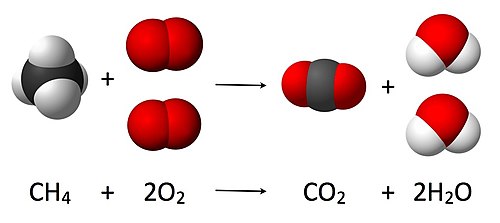
Using knowledge of the stoichiometry of chemical reactions, many calculation problems can be solved, such as:
Elemental analysis.
Molar calculations.
Mass calculations.
Calculation of non-stoichiometric mixtures with the possibility of determining the limiting substance in the reaction.
Reaction yield.
Due to the incredibly small mass of individual atoms and molecules, the unit (u) was created, which expresses atomic mass.
In practice, this is a value equal to 1/12 the mass of the carbon isotope.
This portion of a substance is closely related to the Avogadro constant and is determined as the number of grams of a substance that contains 6.022 10^23 atoms, molecules, or ions.
The molar mass [M] is numerically equal to the atomic or molecular mass, and the unit is g/mol.
This is a substance-specific value that depends largely on temperature and pressure. It is the volume of the substance occupied by one mole of the substance. Under normal conditions, a constant value of 22.4 dm3 is assumed.
Every chemical compound, regardless of its origin and method of production, has a well-defined and constant qualitative and quantitative composition.
Sulfur (IV) oxide, for example, always contains 50% sulfur by weight, and sulfur (VI) oxide contains 40% sulfur by weight.
In a closed system, the mass of the resulting products is equal to the mass of the substrates consumed during the reaction.
The law of conservation of mass is reflected in the need to balance each chemical reaction equation with the appropriate chemical coefficients so that the two sides of the equation are equal in terms of the number of atoms present. Stoichiometric ratios reflect the molar ratios of the reactants present in the chemical reaction.
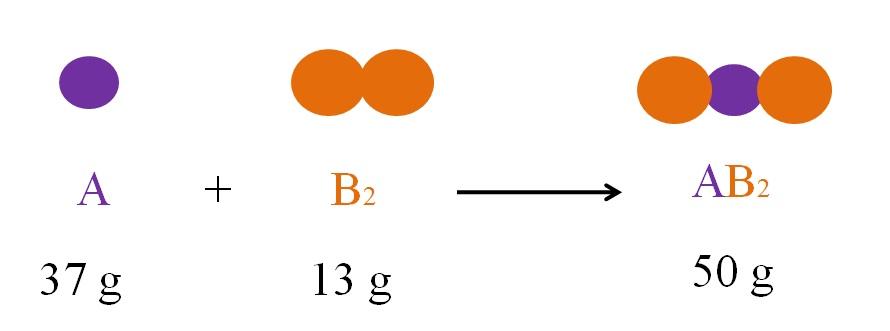
All the necessary information about the relative relationships between chemicals is derived from their chemical reaction equation. It provides important relative and quantitative information.
From the equation for the synthesis of ammonia: 3 H2 + N2 -> 2 NH3, we can make several interpretations: molecular, molar, molar masses, molar volumes, and molecular numbers.
a) Molecularly, we can read that three molecules of hydrogen react with one molecule of nitrogen to form two molecules of ammonia.
b) This also means that three moles of hydrogen react with one mole of nitrogen to form the product of two moles of ammonia.
c) Using the periodic table of chemical elements, which contains the molar masses of individual atoms, we can also conclude from the equation that 6 g of hydrogen reacted completely with 28 g of nitrogen to form 34 g of ammonia.
d) So, assuming standard conditions, we know that one mole of gas occupies 22.4 dm3. This allows us to conclude that 67.2 dm 3 of hydrogen react with 22.4 dm 3 of nitrogen to form 44.8 dm 3 of ammonia.
e) Another useful relationship is Avogadro's law, which states that equal volumes of different gases contain the same number of particles under the same pressure and temperature conditions. Knowing Avogadro's constant of 6.022 10 23 , we know that we need 3 6.022 10 23 hydrogen molecules and 6.022 10 23 nitrogen molecules to carry out the complete chemical reaction of ammonia synthesis. The reaction produces 2 6.022 10 23 molecules of ammonia.
Stoichiometric calculations are also used to determine the yield of a reaction, that is, the ratio of the actual amount of product obtained to the amount derived from the chemical reaction equation.
The oxidation reaction of 30 kg of sulfur (IV) oxide was carried out, and in the presence of a platinum catalyst, the product 34 kg of sulfur (VI) oxide was obtained.
The chemical reaction equation would be: 2 SO2 + O2 -> 2 SO3
From the recorded reaction, we can see that two moles of sulfur (IV) oxide produce the same number of moles of sulfur (VI) oxide. Knowing the molar masses of the reactants, we know that stoichiometrically, assuming a 100% yield, 128 g of SO 2 produces 160 g of SO 3
With this knowledge, we can order the relationship: 0.128 kg SO 2 – 0.160 kg SO 3 30 kg SO 2 – x kg SO 3. From here we will find the amount of sulfur (VI) oxide that would be produced at 100%.
X = 30 kg * 0.160 kg / 0.128 kg = 37.5 kg SO 3
Knowing the theoretical and actual amount of SO 3 , we can calculate the yield with which the reaction occurred. 37.5 kg SO 3 – 100% yield 34 kg SO 3 – x% yield
%W = 34 kg * 100% / 37.5 kg = 92%
The oxidation of sulfur(IV) oxide to sulfur(VI) oxide using a platinum catalyst occurred in 92% yield.
Another application of stoichiometric calculations is determining the formulas of simple chemical compounds. The molecular formula of a chemical compound is either identical or an integer multiple of the empirical formula.
If we know that the general formula of a chemical compound is N x O y , the values of the stoichiometric ratios can be calculated by dividing the mass of the atoms by their atomic masses.
If the molecular weight of a chemical compound is not known, but only its percentage composition, only the elemental formula can be given. This can be a faithful representation of the molecular formula or simply determine the ratio of the individual elements.
The molecular weight of the chemical compound is 92 u, and it is composed of 30.43% nitrogen and 69.57% oxygen.
What is the molecular formula of the chemical compound? Since the sum of the molecules present in the compound is 100%, we can assume that: 92 u – 100%.
This allows us to calculate the individual elemental contents: 92 u – 100%xu of nitrogen – 30.43%
x= 92u * 30.34% / 100% = 28 u nitrogen
Therefore we know that the mass per oxygen atom is: 92 u – 28 u = 64 u Knowing the individual masses of the elements, we can determine the stoichiometric ratios:
x= 28u / 14u = 2
y= 64u / 16u = 4
The molecular formula of this chemical compound is N2 O4.
In the case of reactions in which If the reactants are present in proportions that differ from their corresponding stoichiometry, one of the reactants will react completely and the reaction will stop. It is then present as the limiting reactant, while the second reactant will be present in the system in excess and will also remain present in its primary form when the reaction is complete.
In the laboratory, 40 cm3 of a 0.25 M aluminum sulfate solution was reacted with 50 cm3 of a 0.5 M barium chloride solution.
How many grams of precipitate will form? The chemical reaction equation is:
Al2(SO4) + 3 BaCl2 -> 3 BaSO4 + 2 AlCl3
The first step in understanding the actual course of a reaction is to determine the actual number of moles of the substances involved in the reaction.
n Al2(SO4)2 : C Al2(SO4)2 * V Al2(SO4)2 = 0.25 * 0.04 dm3 = 0.010 mol n BaCl2 : C BaCl2 * V BaCl2 = 0.5 0.05 dm 3 = 0.025 mol
The second step is to determine the deficient substrate based on the stoichiometry of the reaction; This will determine the amount of precipitate formed.
1 mol Al 2 (SO 4 ) 3 - 3 mol BaCl 2 0.010 mol Al 2 (SO 4 ) 3 - x mol BaCl 2
x = 0.010 mol * 3 mol / 1 mol = 0.030 mol
To carry out the reaction completely, with 0.010 mol Al 2 (SO 4 ) 3 , 0.030 mol BaCl 2 must be added to the system.
However, only 0.025 mol of barium chloride reacts, which means there is a deficit and will limit the reaction.
Therefore, the amount of precipitate formed in the reaction must be calculated from the amount of this substrate. The number of moles of barium chloride used according to the stoichiometry of the reaction is equal to the number of moles of precipitate formed, as follows:
n BaSO4 = n BaCl2 0.025 mol BaSO 4 = 0.025 mol BaCl 2
Knowing the number of moles of barium sulfate, we can calculate its mass.
m BaSO4 = n BaSO4 · M BaSO4 m BaSO4 = 0.025 mol * 233.393 g/mol = 5.835 g
The reactions and amounts of substrates given in the task produce 5.835 g of barium sulfate precipitate.
Once you click this button, the reagents will close and you will not be able to change your answer.
We recommend visiting the following materials for further knowledge or understanding on the topic:
1. Stoichiometry. Britannica5. Molar calculations. Mass calculations. Calculation of non-stoichiometric mixtures with the possibility of determining the limiting substance in the reaction. Reaction yield. Elemental analysis.
6. This is a substance-specific value that depends largely on temperature and pressure conditions.
7. The relationship between the actual amount of product obtained and the amount derived from the chemical reaction equation.
References:
1. Leskow, E. C. (2025, 25 marzo). Onda - Concepto, tipos, partes y cómo se propaga. Concepto. https://concepto.de/onda-2/
2. The Editors of Encyclopaedia Britannica. (1998b, julio 20). Stoichiometry | chemistry | Britannica. Encyclopedia Britannica. https://www.britannica.com/science/stoichiometry
3. Libretexts. (2023b, junio 30). Stoichiometry and Balancing Reactions. Chemistry LibreTexts. https://chem.libretexts.org/Bookshelves/Inorganic_Chemistry/Supplemental_Modules_and_Websites_(Inorganic_Chemistry)/Chemical_Reactions/Stoichiometry_and_Balancing_Reactions
4. Admin. (2023e, junio 14). Stoichiometry. BYJUS. https://byjus.com/jee/stoichiometry-and-stoichiometric-calculations/
5. ketzbook. (2016, 15 diciembre). Stoichiometry Made Easy: Stoichiometry Tutorial Part 1 [Vídeo]. YouTube. https://www.youtube.com/watch?v=Gle1bPAZsgg
6. CrashCourse. (2013b, marzo 19). Stoichiometry - Chemistry for Massive Creatures: Crash Course Chemistry #6 [Vídeo]. YouTube. https://www.youtube.com/watch?v=UL1jmJaUkaQ
7. Medicosis Perfectionalis. (2023, 20 septiembre). Stoichiometry - clear & simple (with practice problems) - Chemistry Playlist [Vídeo]. YouTube. https://www.youtube.com/watch?v=wqe97MdzzzU