
Previous Topic

Chemistry

Biology

Home

Math

Physics

Next Topic
Previous Topic
Chemistry
Biology
Home
Math
Physics
Next Topic
The gas laws are a set of chemical and physical laws that determine the behavior of gases in a closed system.
The parameters studied in the different gas laws are:
Pressure: The amount of force applied to a surface. The unit of pressure in SI is the pascal (Pa), but for the mathematical analysis of the gas laws, the unit of atmosphere (atm) is used; 1 atm is equal to 101325 Pa.
Volume: The space occupied by a given amount of mass and is expressed in liters (L).
Temperature: The measure of the internal agitation of gas particles and is expressed in units of kelvin (K). To convert centigrade to kelvin, we have to add 273 to the centigrade.
Moles: This is the mass of the gas. It is represented by the letter n and its units are moles.
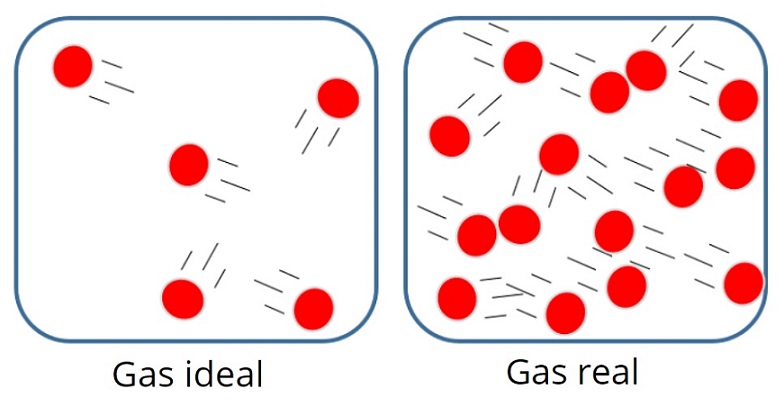
In order to apply the gas laws, we must define what an ideal gas is. An ideal gas is a theoretical gas composed of particles that move randomly and do not interact with each other.
Gases in general behave ideally when they are at high temperatures and low pressures. This is due to the decrease in intermolecular forces.
When a gas is at very low temperatures and/or under extremely high pressure conditions, it no longer behaves ideally. Under these conditions, the gas laws do not apply.
We refer to standard conditions when a substance is at 1 atm of pressure and 273 K of temperature (i.e., 0°C) and has a volume of 22.4 L per mole of substance.
The absolute pressure and volume of a given mass of a confined gas are inversely proportional, as long as the temperature does not vary within a closed system.
Robert Boyle derived this law in 1662. The pressure and volume of an ideal gas are inversely related: as one rises, the other decreases, and vice versa.
Boyle's Law is expressed as: Pressure * Volume = Constant | PV = k
In this law, there are only two variables: pressure and volume. It is assumed that the temperature of the gas and the number of gas molecules in the syringe do not change.
Example: If the gas in a syringe is originally at 1 atm and the volume is 5 mL, then pressure times volume (PV) will equal 5 atm-mL. If the plunger is pushed down to reduce the volume to 2.5 mL, then the pressure will have to increase to 2 atm to keep PV constant.
At constant pressure, the volume of a given quantity of an ideal gas increases with increasing temperature.
Jacques Alexandre Charles made the first hydrogen-inflated balloon flight in 1783 and formulated the law that bears his name in 1787.
Charles's Law is expressed as: Volume / Temperature = Constant | V / T = k
Jacques Alexandre Charles (1746-1823) made the first hydrogen-inflated balloon flight in 1783 and formulated the law that bears his name in 1787.
Example: A vehicle tire is filled with 100 L (V1) of air at 10°C. After riding several kilometers the temperature rises to 40ºC (T2). How much will be the volume of air (V2) in the tire?


Pressure is directly proportional to temperature.
Gay-Lussac's Law is expressed as: Pressure / Temperature = Constant | P / T = k
As the temperature of a gas confined in a container increases, so does the kinetic energy of the gas molecules and, consequently, their collisions with the container walls. The increased frequency of collisions results in increased pressure.
Utensils such as pressure cookers and teapots have safety valves that allow the pressure to be safely released before it reaches dangerous levels.
Example: If the air pressure and temperature in a syringe are originally 1.0 atm and 293 K, and the syringe is placed in boiling water, the pressure will increase to 1.27 atm, according to the following calculations:


Volume is directly proportional to the moles of gas.
The amount of gas is measured in moles (n). The volume of a gas is directly proportional to the number of molecules present, that is, the number of moles of gas.
Avogadro's Law is expressed as: Volume / moles = Constant | V / n = k
Example: A simple example of Avogadro's Law is when we inflate a balloon. As the balloon inflates, more carbon dioxide molecules enter, and the volume increases. Temperature and pressure remain constant.
The ideal gas law combines the laws of Boyle, Charles, Gay-Lussac, and Avogadro, relating the four quantities: pressure, volume, temperature, and moles.
The ideal gas law is expressed as: Pressure * Volume = Moles * Temperature * R | PV = nRT
In this equation, R represents the ideal gas law constant. It can also be expressed as: PV / nT = R
R has a value of:

Example: A 20 L box contains a gas at 300K and 101 kPa pressure. How many moles of gas are in the box?

The rate of diffusion of gases is indirectly proportional to the square root of the mass of the particles.
Diffusion refers to the process of particle movement from an area of high concentration to one of lower concentration. Scottish chemist Thomas Graham determined that the ratio of the rates of diffusion of two gases is equal to the square root of the inverse ratio of their molecular weights. It is expressed:

Example: The ratio of the diffusion rates of ammonia NH3 and oxygen O2 is:

This means that ammonia diffuses at a rate 1.37 times greater than molecular oxygen.
The total pressure of a mixture of gases is equal to the sum of the pressures of each gas individually.
Partial pressures were a concept introduced by the English chemist John Dalton. Dalton's law is expressed as: Total pressure = Pgas1 + Pgas2 + Pgas3 + ...PgasN
Example: A 2 L container contains 0.40 atm of oxygen gas and 0.60 atm of nitrogen gas. The total pressure of the container will be:

Remember to review the answers to the open-ended questions at the bottom of this page.
Once you click this button, the reagents will close and you will not be able to change your answer.
We recommend visiting the following material for further knowledge or understanding of the topic:
1. Gas Laws 2. Gas Laws - Overview 3. Gas Law and Clinical Application6. 128 atm-mL
Pressure * Volume = Constant | 8 atm * 16 mL = 128 atm-mL
7. Ideal gas law; its formula is: Pressure * Volume = Moles * Temperature * R
8. It is the space occupied by a given amount of mass.
9. It is a theoretical gas composed of randomly moving particles that do not interact with each other.
10. Volume / moles = Constant
References:
1. Termoquímica. (s. f.-b). QUÍMICA.ES. https://www.quimica.es/enciclopedia/Termoquímica.html https://www.quimica.es/enciclopedia/Termoquímica.html
2. Gases Law. (s. f.). https://www.chem.fsu.edu/chemlab/chm1045/gas_laws.html https://www.chem.fsu.edu/chemlab/chm1045/gas_laws.html
3. Libretexts. (2023c, noviembre 24). Gas Laws - Overview. Chemistry LibreTexts. https://chem.libretexts.org/Bookshelves/Physical_and_Theoretical_Chemistry_Textbook_Maps/Supplemental_Modules_%28Physical_and_Theoretical_Chemistry%29/Physical_Properties_of_Matter/States_of_Matter/Properties_of_Gases/Gas_Laws/Gas_Laws_-_Overview https://chem.libretexts.org/Bookshelves/Physical_and_Theoretical_Chemistry_Textbook_Maps/Supplemental_Modules_%28Physical_and_Theoretical_Chemistry%29/Physical_Properties_of_Matter/States_of_Matter/Properties_of_Gases/Gas_Laws/Gas_Laws_-_Overview
4. Chandan, G., & Cascella, M. (2023, 28 agosto). Gas Laws and Clinical Application. StatPearls - NCBI Bookshelf. https://www.ncbi.nlm.nih.gov/books/NBK546592/ https://www.ncbi.nlm.nih.gov/books/NBK546592/
5. The Organic Chemistry Tutor. (2023, 8 octubre). Gas Law Formulas and Equations - College Chemistry Study Guide [Vídeo]. YouTube. https://www.youtube.com/watch?v=W2g2iP83JoI https://www.youtube.com/watch?v=W2g2iP83JoI
6. MooMooMath and Science. (2023, 1 junio). Gas Laws-Boyle’s-Charles’s-Gay Lussac’s [Vídeo]. YouTube. https://www.youtube.com/watch?v=Hd7OoTLBZDA https://www.youtube.com/watch?v=Hd7OoTLBZDA
7. CrashCourse. (2013d, mayo 7). The ideal gas Law: Crash course Chemistry #12 [Vídeo]. YouTube. https://www.youtube.com/watch?v=BxUS1K7xu30 https://www.youtube.com/watch?v=BxUS1K7xu30