
Previous Topic
Chemistry
Biology

Home

Math
Physics

Next Topic
Previous Topic
Chemistry
Biology
Home
Math
Physics
Next Topic
All objects, natural or artificial, including human beings, are made up of atoms, which join with other atoms and form molecules. To do this, they can use different types of chemical bonds. And it is precisely in these bonds that we find the key to chemical reactions.
These phenomena cause the chemical bonds between atoms to break and reorganize, giving rise to different substances. If you look around you, you will realize that these types of chemical reactions are constantly occurring. For example, when we breathe or eat, we provide our cells with chemical elements that they transform into energy (and other elements) through a chemical reaction.
The chemical bonds between atoms are broken and new bonds are formed. Two types of substances are involved in this process: those we initially have and know as reactants , and those obtained after the chemical reaction, called products .
The substances around us are constantly changing. However, this does not always mean that a chemical reaction has occurred.
There are also physical changes, when the physical properties of materials change but their chemical properties do not. Some examples of physical changes are changes in the state of matter, mixtures, dissolutions, or the physical separation of substances.
On the other hand, chemical changes do alter the nature of substances, as their molecular structure and the chemical bonds between atoms change.
Atoms are constantly trying to reach the most stable state possible, that is, the one that requires the least energy. To achieve this, they interact with other atoms, exchanging or sharing electrons through chemical bonds. For this reason, in a chemical reaction, atoms do not change. Only the types of chemical bonds that unite them change.
You should also keep in mind that for a chemical reaction to occur, the reactants must collide, since energy is needed to break the chemical bonds between atoms.
In these chemical reactions, two or more substances (reactants) combine to form another, more complex substance (product).
An everyday example is ammonia, which is formed by a synthesis reaction between nitrogen and hydrogen.

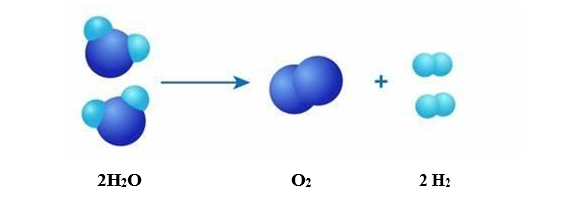
A chemical compound is broken down into simpler substances.
For example, through the electrolysis of water (H2O), it is separated into hydrogen (H) and oxygen (O).
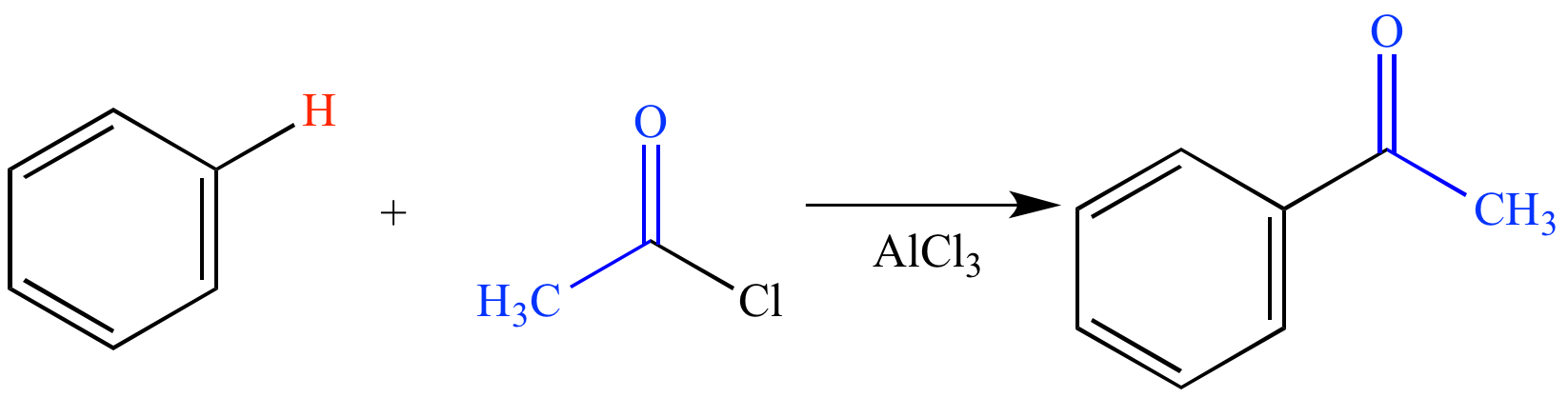
In this type of chemical reaction, elements in compounds are replaced. These can be single reactions (one element displaces another) or double reactions (elements are exchanged). In both cases, the result is the formation of new chemical compounds.
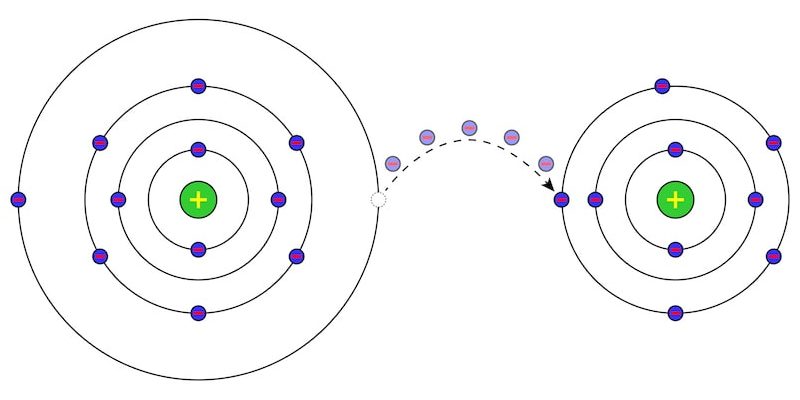
The main characteristic of redox reactions is that there is an exchange of electrons. One of the compounds loses electrons while the other gains them. We say that the compound that loses electrons is oxidized, and the one that gains them is reduced. This is where the name redox reactions come from: REDUCTION-OXIDATION.
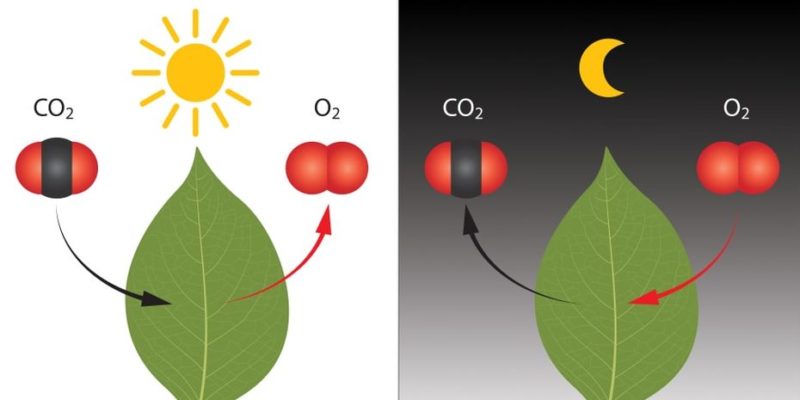
We don't have to look far to find examples of redox reactions. Right now, by breathing, you are carrying out one. From the oxygen in the air, we generate molecules of carbon dioxide and water.
Also, thanks to redox reactions, plants carry out photosynthesis, since this involves the reduction of carbon dioxide into sugars and the oxidization of water, forming oxygen.
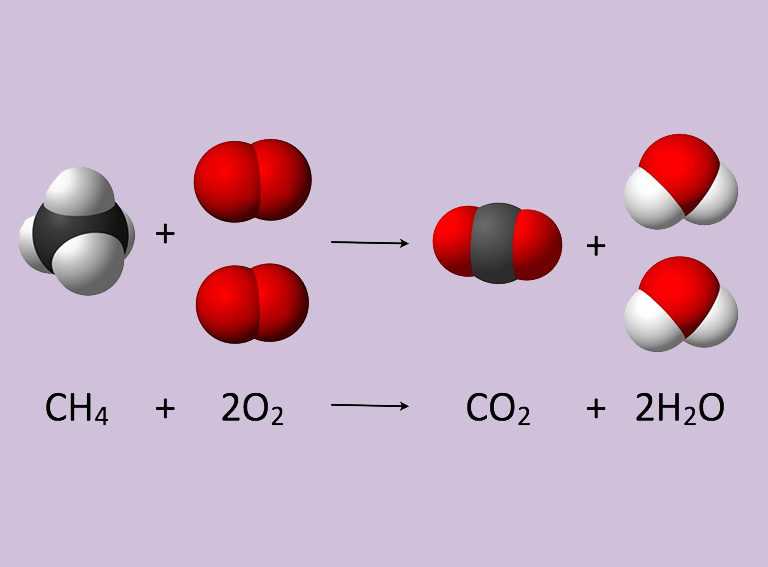
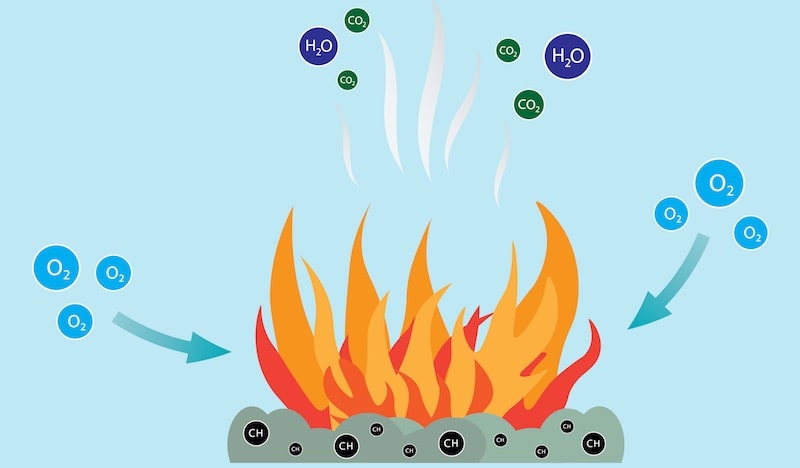
Combustion is actually a type of redox reaction. We differentiate it because, in the case of combustion reactions, oxidation occurs extremely quickly and powerfully. For this to happen, a combustible material combines with oxygen, releasing energy—usually heat and light. Carbon dioxide and water are generated as products.
You can see clear examples of the combustion reaction when you warm yourself in front of a fireplace. The wood burns and combines with oxygen to form carbon dioxide and water vapor, while simultaneously generating a large amount of chemical energy in the form of heat and light.
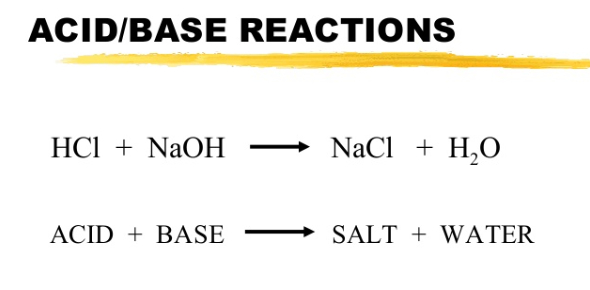
This type of chemical reaction involves a basic substance and an acidic substance neutralizing each other. The result is a neutral compound and water.
For example, when hydrochloric acid reacts with sodium hydroxide, salt (sodium chloride) and water are produced.
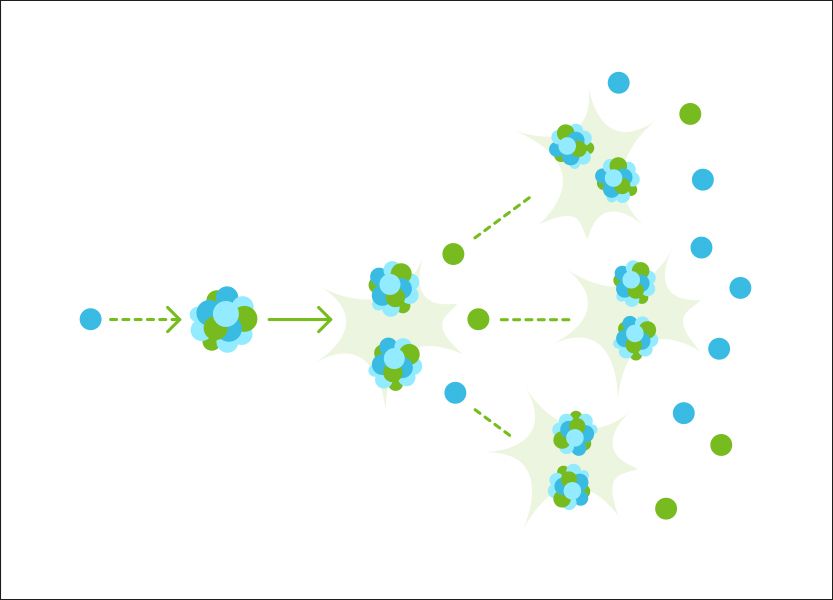
In nuclear reactions, the electrons in atoms are not modified, but rather their nucleus. There are two types of nuclear chemical reactions: fusion , in which different atoms combine; and fission , in which the nucleus of atoms is fragmented.
For example, nuclear reactions are used to obtain energy. This is what happens with uranium when it is bombarded with neutrons in an attempt to break up its nucleus.
We call exothermic reactions those that cause the release of energy, which is usually at least in the form of heat. Although, for example, in the case of explosions, kinetic energy is also released.
On the other hand, when energy is absorbed, an endothermic reaction is taking place. As a result, the final product is more energetic than the reactants.
Chemical reactions take place in laboratories but also outside of them. In factories, in the atmosphere, in our kitchens, and even inside our bodies, chemical reactions of all kinds are constantly taking place.
Remember to review the answers to the open-ended questions at the bottom of this page.
Once you click this button, the questions will be closed and you will not be able to change your answer.
We recommend visiting the following materials for further knowledge or understanding on the topic:
1. Chemical Reactions 2. Introductiom to chemical reactions 3. What is a Chemical Reaction?1. A physical change only alters the physical properties of a substance, without changing its chemical composition (e.g., a change of state). A chemical change, on the other hand, modifies the molecular structure and the bonds between atoms, forming new substances.
2. It is a chemical reaction in which two or more substances combine to form a more complex product. An example is the formation of ammonia (NH₃) from nitrogen (N₂) and hydrogen (H₂).
3. In a redox reaction, one compound loses electrons (oxidation) and another gains them (reduction). They are essential in natural processes such as cellular respiration and photosynthesis.
4. A combustible material reacts with oxygen, releasing energy in the form of heat and light, and producing carbon dioxide (CO₂) and water (H₂O).
5. In an exothermic reaction, energy (heat or light) is released, while in an endothermic reaction, energy is absorbed, making the final products more energetic than the reactants.
References:
1. Valverde, M., Schwarz, Z. &., & Valverde, M. (2023, 13 marzo). ¿Qué es una reacción química? Definición, ejemplos y tipos de reacciones químicas. ZS España. https://www.zschimmer-schwarz.es/noticias/que-es-una-reaccion-quimica-definicion-ejemplos-y-tipos-de-reacciones-quimicas/
2. Kotz, C, J., Treichel, & M, P. (2025, 24 marzo). Chemical reaction | Definition, Equations, Examples, & Types. Encyclopedia Britannica. https://www.britannica.com/science/chemical-reaction
3. What is a chemical reaction? - BBC Bitesize. (2024, 11 julio). BBC Bitesize. https://www.bbc.co.uk/bitesize/articles/zwxhk2p#zbhqwnb
4. Lesson 6.1: What is a Chemical Reaction? - American Chemical Society. (s. f.). American Chemical Society. https://www.acs.org/middleschoolchemistry/lessonplans/chapter6/lesson1.html
5. Top Fives. (2021, 1 abril). 15 Incredible chemical reactions [Vídeo]. YouTube. https://www.youtube.com/watch?v=trgDHBPLJEE
6. The Organic Chemistry Tutor. (2017a, agosto 17). Predicting The Products of Chemical Reactions - Chemistry Examples and Practice Problems [Vídeo]. YouTube. https://www.youtube.com/watch?v=MYmrWHzT1oI
7. Be Smart. (2016, 17 mayo). 6 Chemical reactions that changed history [Vídeo]. YouTube. https://www.youtube.com/watch?v=jb4CMnT2-ao